Generative AI Mastery Quizzes
APIs
Question 4
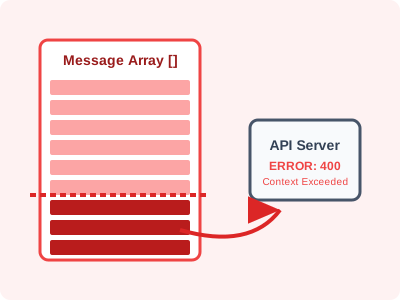
Examine the image below representing a standard terminal chat app loop. What critical flaw will eventually cause this architecture to crash if left unmanaged?
Question 15
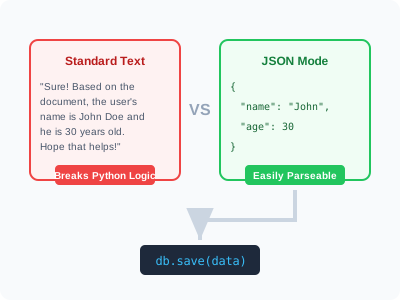
Based on the image below, why is setting response_format={ "type": "json_object" } critical when building data-extraction pipelines?
List of Questions
Question 1: When building an AI application, why do professional developers typically use a provider's official Python SDK (e.g., `pip install openai`) instead of writing raw HTTP requests using `requests.post()`?
Answers: The SDK abstracts away complex HTTP headers, JSON serialization, and error handling, reducing boilerplate code..
Question 2: What is the absolute most important security rule when dealing with LLM API keys in your Python code?
Answers: Never hardcode the key in your script; always load it dynamically from an environment variable (like a `.env` file)..
Question 3: Because LLM APIs are stateless, how do developers build a chat application that 'remembers' the conversation?
Answers: By maintaining a local array (list) of all previous messages and sending that entire array back to the API with every new user input..
Question 4: Examine the image below representing a standard terminal chat app loop. What critical flaw will eventually cause this architecture to crash if left unmanaged?
Answers: The message array will eventually exceed the LLM's Context Window, resulting in an API rejection error..
Question 5: What is the primary purpose of using the `tiktoken` library in an OpenAI Python application?
Answers: To count the exact number of tokens in a Python string locally (offline) before sending it to the API..
Question 6: When making an API call, setting the parameter `stream=True` drastically improves User Experience (UX). How does it do this?
Answers: It uses Server-Sent Events (SSE) to send the AI's response back chunk-by-chunk as it is generated, reducing perceived latency to milliseconds..
Question 7: Which Python libraries are specifically designed to help AI developers rapidly prototype interactive, web-based Chat UIs without needing to write complex JavaScript or React?
Answers: Streamlit, Gradio.
Question 8: In enterprise software, how do developers typically create 'Dynamic Prompts' to inject live user data or database results into the prompt string before calling the API?
Answers: By using Python f-strings (e.g., `f"Summarize this: {document_text}"`)..
Question 9: When attempting to refine an AI's output, what does 'A/B Testing' prompts involve?
Answers: Routing a percentage of user traffic to 'Prompt A' and the rest to 'Prompt B' to statistically measure which one produces better, more reliable results..
Question 10: Why is 'Prompt Versioning' considered a critical engineering best practice?
Answers: Because changing a single word in a System Prompt can drastically alter the AI's behavior; versioning allows you to roll back if accuracy degrades..
Question 11: To build resilient applications, developers often use the Python `tenacity` library (e.g., `@retry`). What specific problem does this solve?
Answers: It automatically catches network failures or '429 Rate Limit' errors and safely retries the API call, preventing the app from crashing..
Question 12: What happens if a developer does NOT set a strict `timeout` parameter (e.g., `timeout=15.0`) in their API request?
Answers: If the provider's server hangs, the application will wait indefinitely, leaving the user staring at a loading screen forever..
Question 13: Select all the strategies that represent a robust 'Model Tiering' architecture:
Answers: Routing simple tasks (like text formatting) to a fast, cheap model (e.g., GPT-4o-mini)., Routing complex reasoning or coding tasks to a high-tier, expensive model (e.g., Claude Opus)..
Question 14: What is the primary architectural purpose of implementing 'Fallback Models'?
Answers: To ensure continuous uptime; if Provider A's servers go down, the code automatically routes the exact same prompt to Provider B..
Question 15: Based on the image below, why is setting `response_format={ "type": "json_object" }` critical when building data-extraction pipelines?
Answers: It guarantees the AI responds with perfectly formatted, parseable data structures, preventing conversational text from breaking downstream Python logic..
Question 16: What are the primary benefits of integrating LLMOps tools (like LangSmith or Helicone) into your application?
Answers: They automatically log every prompt sent by users., They track token costs and API latency on a centralized dashboard..
Question 17: If an enterprise is concerned about data privacy, why should they build an internal tool using an AI provider's API rather than letting employees use the free public web interface?
Answers: Enterprise APIs generally guarantee 'Zero Data Retention', meaning corporate payloads are not used to train future models..
Question 18: What is the notorious 'Infinite Loop' bug that often occurs when automating AI agents?
Answers: An AI generates an error, the code automatically feeds that error back to the AI asking for a fix, and the AI generates the same error again indefinitely, draining the API budget..
Question 19: During testing, users report that your customer service chatbot is hallucinating random facts. Which API parameter adjustment is the most logical first step?
Answers: Lower the Temperature to 0.1 to force deterministic, focused behavior..
Question 20: What is the purpose of using 'Delimiters' (like `<doc></doc>` or `"""`) in a complex API payload?
Answers: To cleanly separate the developer's system instructions from the untrusted human input, helping prevent prompt injection attacks..