Generative AI Mastery Quizzes
AI RAG Systems
Question 7
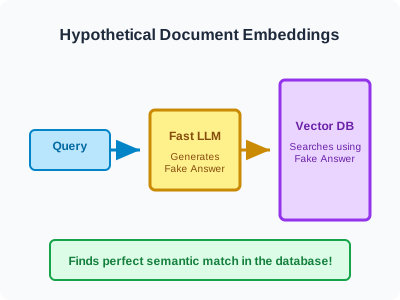
Examine the image below. What advanced RAG retrieval hack involves asking an LLM to generate a 'fake' answer to embed and search with, rather than embedding the user's original question?
List of Questions
Question 1: What is the primary function of the 'Retrieval' step in a RAG pipeline?
Answers: To intercept a prompt and search an external database for factual, relevant context before the LLM generates an answer..
Question 2: When ingesting a 1,000-page PDF into a RAG system, why do developers use a 'Chunk Overlap' strategy?
Answers: To ensure that if a sentence or core concept is split between two chunks, the semantic meaning isn't lost at the cut-off point..
Question 3: Which text splitting method is generally considered the best practice for processing natural human language (like articles or manuals)?
Answers: Recursive Character Splitting (cutting at paragraphs, then sentences, then words)..
Question 4: What is the difference between a Dense Vector and a Sparse Vector in retrieval?
Answers: Dense vectors capture deep semantic meaning and concepts; Sparse vectors capture exact keyword frequencies..
Question 5: When a Vector Database compares a user's query vector against millions of document vectors, what mathematical formula is most commonly used to measure their similarity?
Answers: Cosine Similarity.
Question 6: What advanced retrieval strategy solves the issue where Semantic (Dense) search fails to find specific acronyms, names, or serial numbers?
Answers: Hybrid Search (combining Dense semantic search with Sparse BM25 keyword search)..
Question 7: Examine the image below. What advanced RAG retrieval hack involves asking an LLM to generate a 'fake' answer to embed and search with, rather than embedding the user's original question?
Answers: HyDE (Hypothetical Document Embeddings).
Question 8: What is the primary role of a 'Cross-Encoder' (or Re-Ranker) in an advanced RAG pipeline?
Answers: It takes a broad list of retrieved chunks (e.g., top 20) and rigorously scores them against the user's prompt, promoting only the absolute most relevant chunks to the final LLM..
Question 9: Why is it dangerous to retrieve 30 document chunks and stuff all of them into the LLM's prompt for the Generation phase?
Answers: Due to the 'Lost in the Middle' phenomenon, the LLM will pay attention to the first and last chunks but will likely ignore or forget the information buried in the middle chunks..
Question 10: Select the correct example of a 'Grounding Constraint' used in a RAG System Prompt:
Answers: 'Answer the user's question using ONLY the provided retrieved context. If the answer is not present, reply "I do not know."'.
Question 11: In the RAGAS evaluation framework, what does the 'Faithfulness' metric measure?
Answers: Whether the LLM generated its answer strictly using the retrieved context without hallucinating outside facts..
Question 12: In the RAGAS evaluation framework, what does 'Context Precision' measure?
Answers: Did the Re-Ranker put the most relevant, highly-accurate chunks at the very top of the retrieved list, free of noisy/irrelevant data?.
Question 13: How is Role-Based Access Control (RBAC) securely implemented in an enterprise RAG system?
Answers: By applying 'Metadata Filtering' at the Vector Database level; appending the user's ID/Role to the query so the database mathematically excludes chunks the user lacks permission to view..
Question 14: What is 'Query Expansion'?
Answers: Intercepting a user's short prompt and using a fast LLM to rewrite it into multiple detailed variations to broaden the vector search coverage..
Question 15: Which of the following describes the difference between Context Precision and Context Recall in RAG evaluation?
Answers: Context Precision asks: Are the retrieved chunks highly relevant and free of noisy garbage data?, Context Recall asks: Did the system successfully find ALL the information required to fully answer the user's complex question?.