Generative AI Mastery Quizzes
AI Agents
Question 3
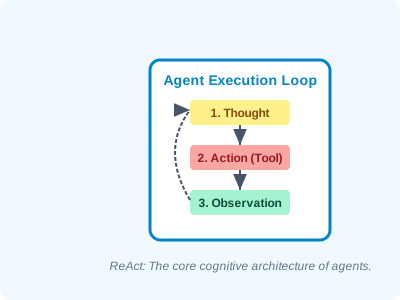
Examine the image below. The foundational architecture for AI Agents is the 'ReAct' framework. What are the three steps in the ReAct loop?
Question 8
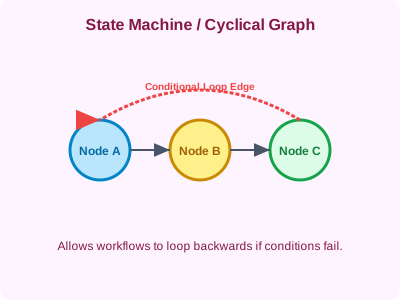
Examine the image below. When building complex Multi-Agent Systems, developers often use 'LangGraph'. What is the core architectural concept behind LangGraph?
Question 10
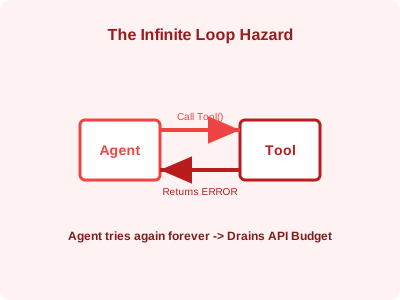
Based on the image below, what notorious security/cost risk occurs when an autonomous agent encounters an error it cannot fix?
Question 12
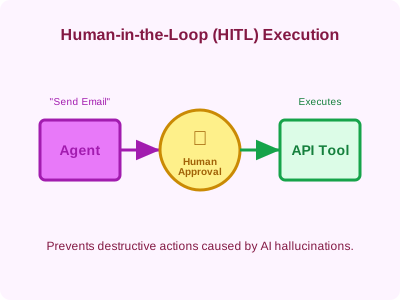
Based on the image below, what critical security mechanism must be implemented before an AI agent is allowed to execute a tool that modifies databases or sends emails?
List of Questions
Question 1: What is the defining characteristic that separates an AI Agent from a traditional AI Chatbot?
Answers: Chatbots are reactive and stop after answering, while Agents are autonomous, executing loops of reasoning and using tools to achieve a high-level goal..
Question 2: Which of the following make up the three core components of an AI Agent?
Answers: The Brain (LLM for reasoning), Memory (Short-term context and Long-term Vector DBs), Tools (APIs and functions to interact with the world).
Question 3: Examine the image below. The foundational architecture for AI Agents is the 'ReAct' framework. What are the three steps in the ReAct loop?
Answers: Thought, Action, Observation.
Question 4: How does an LLM execute a 'Tool' (like scraping a website)?
Answers: The LLM outputs a JSON formatted request specifying the tool name and arguments; the developer's Python code reads the JSON, runs the actual tool, and returns the result to the LLM..
Question 5: Why is giving an AI Agent access to a 'Python REPL' (a secure coding sandbox) highly recommended for data analysis tasks?
Answers: Because LLMs are bad at exact math and logic. By writing and executing a Python script in a sandbox, the agent offloads the math to a deterministic calculator..
Question 6: What is the primary benefit of the 'Plan-and-Solve' agent architecture?
Answers: It separates the creation of a step-by-step master plan from the execution of those steps, drastically reducing hallucinations in complex tasks..
Question 7: How do developers give an AI Agent 'Long-Term Memory' across multiple user sessions?
Answers: By extracting key facts and preferences from the conversation, storing them as embeddings in a Vector Database, and injecting them into future sessions..
Question 8: Examine the image below. When building complex Multi-Agent Systems, developers often use 'LangGraph'. What is the core architectural concept behind LangGraph?
Answers: It models agent workflows as State Machines (Graphs) using Nodes and Edges, allowing for cyclical loops and dynamic routing based on conditional logic..
Question 9: In a Multi-Agent System (MAS), what is the specific function of a 'Router Agent' (or Supervisor)?
Answers: To receive the user's initial goal and delegate the task to the most appropriate, specialized worker agent..
Question 10: Based on the image below, what notorious security/cost risk occurs when an autonomous agent encounters an error it cannot fix?
Answers: The Infinite Loop.
Question 11: What is the recommended architectural response if an LLM hallucinates a tool call (e.g., requesting a `search_google` tool when only `search_bing` was provided)?
Answers: Catch the error programmatically and return a polite observation to the LLM: 'Tool not found. Please select from the provided JSON list.'.
Question 12: Based on the image below, what critical security mechanism must be implemented before an AI agent is allowed to execute a tool that modifies databases or sends emails?
Answers: Human-in-the-Loop (HITL) Execution.
Question 13: What is 'Indirect Prompt Injection' in the context of an AI Agent?
Answers: An agent using a tool (like a web scraper) to read an external website that contains hidden malicious instructions, which the agent then unwittingly follows..